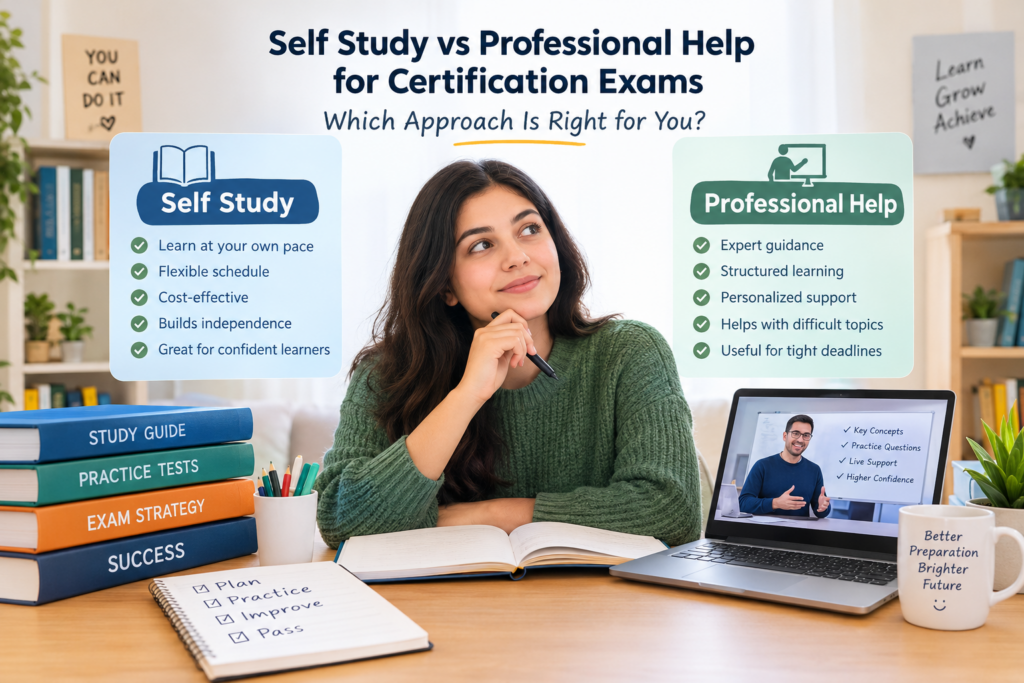
Preparing for a certification exam can be stressful, especially when you are unsure about the best way to study. Should you rely on your own preparation, join a structured course, work with a tutor, or combine different methods?
The answer depends on your existing knowledge, the complexity of the examination, your available preparation time, and the way you learn best.
Choosing the wrong approach can result in wasted time, unnecessary expenses, and disappointing results. A well planned strategy, on the other hand, can help you understand difficult concepts, improve your test taking skills, and walk into the examination with greater confidence.
Certification exams also differ considerably from one another. Some focus primarily on factual knowledge, while others require candidates to analyse scenarios, apply technical concepts, solve problems, or demonstrate professional judgement. Because of these differences, your preparation method should be based on the specific demands of your examination.
Why Your Exam Preparation Strategy Matters
Studying for more hours does not automatically guarantee better results. The quality and structure of your preparation are equally important.
Before opening a textbook or enrolling in a preparation course, take some time to understand the official exam structure. Find out which subjects are tested, how much weight each section carries, how questions are presented, and how much time you will have to complete the examination.
For example, an examination based mainly on factual questions may be manageable through independent reading and repeated revision. An exam containing complex case studies or practical scenarios may require considerably more application based practice.
Your preparation should therefore involve more than memorising information. You need to understand concepts, practise applying them, identify weak areas, and learn how to manage your time under examination conditions.
What Does Self Study Really Involve?
Self study is often described as the simplest preparation method, but effective independent learning requires planning and discipline.
Rather than randomly watching videos or reading different books, begin with the official exam blueprint. Divide the syllabus into smaller sections and create realistic weekly goals.
Your resources might include:
- Official study guides
- Recommended textbooks
- Online lessons
- Practice questions
- Mock examinations
- Revision notes
- Subject specific tutorials
Practice tests should become part of your preparation well before the final week. They can show you which subjects you understand and which ones require additional attention.
After completing a practice test, review your incorrect answers carefully. Ask yourself why you made each mistake. Was the concept unfamiliar? Did you misunderstand the question? Did you rush because of the time limit?
This process can be more valuable than simply looking at your final score.
When Is Self Study the Right Choice?
Self study can work particularly well when you already have a solid understanding of the subject.
For example, professionals who regularly use the concepts covered by an examination may only need to refresh their knowledge and become familiar with the test format. Similarly, students who have successfully prepared for previous examinations independently may already have effective study habits.
Self study may be suitable when:
- The examination syllabus is clearly defined.
- Official preparation materials are available.
- You have sufficient time to study.
- You are comfortable learning independently.
- You can maintain a consistent schedule.
- The subject is already familiar to you.
- You perform well on practice tests.
One of the biggest benefits of independent preparation is flexibility. You can decide when and where you study instead of following someone else’s timetable.
However, flexibility can become a disadvantage if you lack discipline. A study schedule only works when you actually follow it.
When Is Professional Exam Preparation More Useful?
Some examinations are considerably more challenging than others. They may contain complicated scenarios, technical applications, calculations, or questions requiring professional judgement.
In such situations, professional preparation support can make difficult concepts easier to understand.
Professional guidance can be particularly useful if you have failed an examination previously. Instead of repeating the same study routine, an instructor can help you identify the specific areas causing problems and develop a more focused strategy.
You may also benefit from professional support when:
- Your examination date is approaching quickly.
- You are struggling with several major topics.
- You have difficulty understanding practice questions.
- You need someone to keep you accountable.
- You repeatedly score poorly on mock examinations.
- You are unfamiliar with the examination format.
- You have limited experience with the subject.
The purpose of professional assistance should be to strengthen your preparation and understanding. It should not replace your own responsibility for learning the material and completing the examination honestly.
Why Shortcuts Can Create Bigger Problems
Exam stress can sometimes lead students to search for quick solutions instead of reliable preparation methods.
For example, someone struggling with the GED may search for phrases such as Pay Someone To Take My GED Exam because they feel unprepared or overwhelmed.
However, having another person complete an examination on your behalf is not a legitimate study strategy. It can violate examination policies, compromise the validity of the result, and potentially create serious academic or professional consequences.
If you are struggling with the GED, certification exams, or other assessments, legitimate tutoring, preparation courses, practice materials, and subject specific guidance are much safer options.
The goal of preparation should always be to help you develop the knowledge and confidence required to complete the examination yourself.
The Benefits of a Hybrid Study Approach
You do not necessarily have to choose between completely independent learning and full time professional instruction.
A combination of both approaches can often provide a practical middle ground.
For example, you might begin by studying independently using official materials. After completing several practice tests, you can identify the topics where you consistently struggle. You can then seek targeted guidance for those specific subjects.
This approach prevents you from spending money on instruction for topics you already understand while still giving you access to expert explanations when you need them.
A hybrid strategy may also work well for students who have demanding work or family schedules. Independent study gives them flexibility, while occasional professional guidance helps them stay on track.
Build a Certification Exam Study Plan
A good preparation plan should begin with your examination date.
Work backwards from the test and divide the syllabus into manageable sections. Give additional time to subjects that carry greater weight or areas where your knowledge is weaker.
For example, your plan could look like this:
Weeks 1 to 2: Understand the exam structure and review the complete syllabus.
Weeks 3 to 5: Study the major topics and complete topic specific practice questions.
Weeks 6 to 7: Take timed mock examinations and review incorrect answers.
Final week: Focus on revision, weak areas, formulas, terminology, and exam strategy.
Avoid creating an unrealistic timetable. If your schedule only allows one or two hours of study each evening, build your plan around that reality.
A realistic schedule that you consistently follow is more valuable than an ambitious schedule that you abandon after a few days.
Practice Tests Are Essential
Practice examinations can tell you much more than whether you are getting questions right or wrong.
They can help you understand how quickly you work, which topics cause problems, and whether you can maintain concentration throughout a timed assessment.
After every mock exam, create a list of:
- Incorrect answers
- Questions answered through guessing
- Topics that took too much time
- Concepts you still find confusing
- Subjects requiring additional revision
Use this information to adjust your study plan.
If you repeatedly struggle with the same subject, do not simply take another practice test and hope the problem disappears. Return to the underlying concept, review it carefully, and then test yourself again.
GED Preparation Requires the Right Strategy Too
The same principles apply when preparing for the GED. The examination assesses several academic areas, meaning students need to understand different types of questions and apply knowledge under time pressure.
A student who is already comfortable with reading comprehension may be able to prepare independently for that section. Someone who struggles with mathematical concepts may need additional tutoring or structured preparation.
This is why searches such as Pay Someone To Take GED often reflect frustration rather than an effective solution. Instead of looking for someone else to complete the examination, students should identify the subjects creating difficulty and find appropriate educational support.
The same applies to searches such as Take My GED Test For Me. While such phrases may appear online, completing an examination through someone else does not build the knowledge required for future education or employment.
Common Mistakes Students Make
Even students who are highly motivated can make preparation mistakes.
Studying Without the Exam Blueprint
Without understanding the official syllabus, you may spend too much time on minor topics while overlooking areas that carry significant weight.
Relying on One Resource
A single textbook may not explain every concept clearly. Combine reliable resources, practice questions, and mock examinations where appropriate.
Waiting Until the End for Practice Tests
Practice tests should be introduced during your preparation, not only during the final few days. Early testing gives you enough time to correct weaknesses.
Memorising Without Understanding
Memorisation can be useful for facts and terminology, but many certification exams require you to apply what you have learned.
Ignoring Time Management
Knowing the material is only part of the challenge. You also need to answer questions efficiently within the available time.
Cramming Before the Exam
Trying to learn everything in the final few days can increase anxiety and make it harder to retain information. Use the final stage for revision rather than starting the entire syllabus again.
How Online Support Can Help With Preparation
Online learning has made it easier for students to access preparation materials, tutors, practice tests, and educational resources from almost anywhere.
However, students should carefully distinguish between legitimate educational assistance and services that offer to complete assessments on their behalf.
For example, someone searching for Pay Someone For Online GED Exam Help may actually need tutoring, practice questions, or assistance understanding difficult concepts.
Likewise, a search for Pay Someone To Take My GED Test Online may indicate that the student is feeling overwhelmed by the examination process. Instead of relying on someone else to take the test, the better approach is to identify the reason behind the difficulty and address it through legitimate preparation.
Good online support should help you learn, practise, and become more confident in your own abilities.
How to Choose the Best Preparation Method for You
Before deciding how to prepare, ask yourself a few important questions.
How Strong Is My Current Knowledge?
If you already understand most of the material, self-study may be sufficient. If you are starting from the beginning, structured guidance may be more beneficial.
How Difficult Is the Examination?
Consider the question format and level of application required. Exams involving complex scenarios may require more preparation than straightforward knowledge-based tests.
How Much Time Do I Have?
A longer preparation period gives you more opportunity to learn independently. If your examination is approaching quickly, structured support may help you use your remaining time more efficiently.
How Are My Practice Scores?
Your mock examination results provide valuable evidence about your readiness. If your scores improve consistently, your preparation strategy may be working. If they remain low, consider changing your approach.
Can I Stay Consistent?
Self-study requires motivation and accountability. If you regularly postpone your study sessions, joining a course or working with a tutor may provide useful structure.
Final Thoughts
Choosing between self-study and professional exam preparation is not about finding one method that works for everyone. It is about understanding your own needs and matching them with the demands of the examination.
Independent learning can be highly effective when you have a strong foundation, enough time, reliable resources, and the discipline to follow a study plan. Professional guidance can be valuable when you are struggling with difficult concepts, repeatedly failing practice tests, or working under a tight deadline.
For many students, the most effective solution is a combination of both. Build your foundation independently, use practice tests to measure progress, and seek legitimate educational support when you encounter areas that require additional explanation.
Most importantly, do not allow exam pressure to push you toward shortcuts that could compromise your results. Whether you are preparing for a professional certification or the GED, genuine preparation gives you something that shortcuts cannot: the knowledge and confidence to handle the examination yourself.
Frequently Asked Questions
1. Is self study enough to pass a certification exam?
Yes, self study can be enough for many examinations. It works particularly well when you already have a strong foundation, understand the exam format, have reliable study resources, and can maintain a consistent schedule.
2. When should I consider professional exam preparation help?
Professional guidance can be useful when you repeatedly struggle with specific topics, have limited preparation time, perform poorly on practice exams, or find it difficult to understand complex concepts independently.
3. How many practice tests should I take before my exam?
There is no universal number because preparation requirements vary. Instead of focusing solely on the number of tests, concentrate on reviewing your mistakes and improving your weak areas after every practice examination.
4. What is the best way to prepare for the GED?
Begin by understanding the GED subjects and question formats. Use reliable study materials, create a realistic schedule, practise regularly, and spend additional time on subjects where your practice results show weaknesses.
5. Can professional help replace independent studying?
Professional guidance should complement your preparation rather than replace it. A tutor or preparation course can explain difficult concepts, provide feedback, and improve accountability, but you still need to understand and practise the material yourself.