Introduction
Getting accepted into a nursing program requires more than academic ambition. Applicants must demonstrate that they possess the foundational knowledge and skills needed to succeed in demanding healthcare courses. One of the most widely used entrance assessments for nursing and allied health programs is the Test of Essential Academic Skills (TEAS), developed by Assessment Technologies Institute (ATI).
Understanding the ATI examination, completing TEAS exam registration, and developing an effective preparation strategy can make the application process significantly more manageable.
Whether you are preparing for your first attempt or hoping to improve an earlier score, this comprehensive guide explains the examination structure, registration process, study techniques, and common mistakes to avoid.
What Is the ATI TEAS Examination?
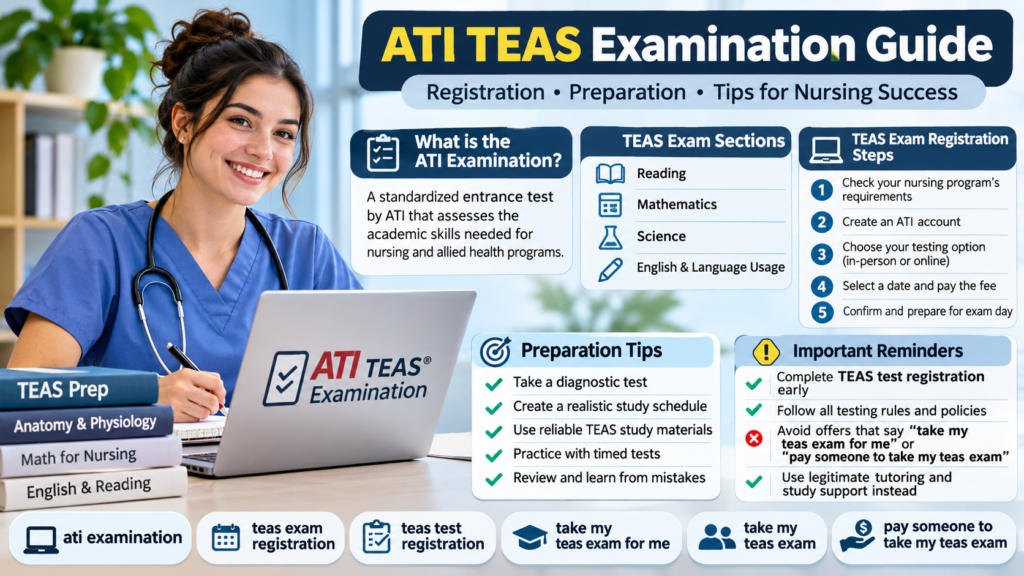
The ATI TEAS is a standardised assessment used by many nursing and allied health programs to evaluate applicants’ academic readiness. Its purpose is to measure essential abilities that students will need throughout their education.
Unlike examinations that focus exclusively on memorization, the TEAS measures knowledge, comprehension, problem-solving, and analytical reasoning across several subjects.
The examination includes four major areas:
- Reading: Understanding passages, identifying central ideas, interpreting information, and drawing conclusions.
- Mathematics: Working with numbers, algebraic expressions, measurements, and data interpretation.
- Science: Understanding human anatomy, physiology, biology, chemistry, and scientific reasoning.
- English and Language Usage: Applying grammar, punctuation, sentence structure, vocabulary, and language conventions.
Nursing schools use TEAS results alongside other admission requirements. However, individual institutions establish their own minimum scores, competitive benchmarks, and testing policies.
Therefore, applicants should review their chosen program’s admission criteria before scheduling the examination.
Why Is the ATI Examination Important for Nursing Applicants?
The ATI examination helps educational institutions identify applicants who demonstrate readiness for academically challenging healthcare programs.
Nursing education involves understanding scientific concepts, interpreting clinical information, calculating dosages, and communicating accurately. These responsibilities require strong foundational academic abilities.
The TEAS provides institutions with a standardised way to assess some of those abilities before admission.
A strong result may improve an applicant’s competitiveness, particularly when applying to programs that receive more applications than available seats.
However, a high TEAS score does not automatically guarantee admission. Colleges may also consider academic transcripts, prerequisite grades, interviews, and other institutional requirements.
For this reason, applicants should approach the assessment as one important component of a broader admission strategy.
Understanding the ATI TEAS Exam Format
Knowing the structure of an examination allows students to allocate their preparation time more effectively.
The ATI TEAS Version 7 consists of 170 questions, with 150 scored questions and 20 unscored questions. The total testing time is 209 minutes.
| Examination Section | Questions | Time Allowed |
|---|---|---|
| Reading | 45 | 55 minutes |
| Mathematics | 38 | 57 minutes |
| Science | 50 | 60 minutes |
| English and Language Usage | 37 | 37 minutes |
| Total | 170 | 209 minutes |
Questions may include multiple-choice, multiple-select, fill-in-the-blank, ordered-response, and other alternative formats.
Understanding these variations is important because candidates must demonstrate both subject knowledge and familiarity with different question styles.
Students should practice under timed conditions rather than relying entirely on untimed worksheets or memorized explanations.
How to Complete TEAS Exam Registration
Completing TEAS exam registration correctly is essential because scheduling mistakes can interfere with nursing application deadlines.
Before registering, candidates should confirm whether their preferred institution accepts online testing, in-person testing, or both.
Step 1: Review Your Nursing Program’s Requirements
Start by checking the official admissions website of your nursing school.
Determine whether the program has a minimum TEAS score, limits the number of attempts, requires a waiting period between attempts, or accepts results from particular testing arrangements.
These details can differ considerably between institutions.
Step 2: Create an ATI Account
Visit the official ATI Testing website and create an account using accurate personal information.
Candidates should ensure that the name on their account matches the identification they intend to present on examination day.
Incorrect registration information can create avoidable identification problems.
Step 3: Choose Your Examination Arrangement
Depending on the options available, applicants may be able to take the examination at an educational institution, an authorised testing center, or through remote proctoring.
Students should select an arrangement accepted by their nursing program and compatible with their circumstances.
Step 4: Select a Date and Complete Payment
Review available dates, applicable examination fees, cancellation rules, and rescheduling policies.
After choosing an appropriate appointment, complete payment through the authorised registration process.
Retain the confirmation email and any testing instructions.
Step 5: Prepare for Examination Day
For remotely proctored examinations, verify the computer, internet connection, testing environment, and technical requirements in advance.
For in-person examinations, confirm the testing location, identification requirements, and permitted materials.
Completing these preparations early reduces unnecessary stress.
Common TEAS Test Registration Mistakes
Although TEAS test registration is generally straightforward, applicants sometimes overlook requirements that affect their examination experience.
One frequent mistake is registering without verifying the nursing school’s admission deadline. Candidates may discover too late that their results will not be available when applications close.
Another mistake is choosing an examination arrangement that the intended institution does not accept.
Students may also misunderstand retake restrictions or assume that all testing fees are refundable.
Before confirming an appointment, applicants should review the relevant policies carefully.
Registration should also be completed through authorised channels. Unofficial websites offering guaranteed admission, altered results, or suspicious examination arrangements should be avoided.
How to Prepare Effectively for the ATI TEAS Exam
Successful preparation requires consistent practice, realistic scheduling, and a clear understanding of personal weaknesses.
Rather than studying every subject equally, candidates should identify which areas require the most attention.
Start With a Diagnostic Assessment
Take a practice test before beginning intensive preparation.
The results can help identify specific weaknesses, such as fractions, scientific reasoning, reading comprehension, or grammar.
Use these findings to organise your study priorities.
Create a Realistic Study Schedule
A preparation period of six to eight weeks can provide useful structure for many applicants, although the appropriate duration depends on existing knowledge and available study time.
Divide study sessions between concept revision, practice questions, and error analysis.
For example, candidates struggling with science may dedicate additional sessions to anatomy and physiology while maintaining shorter revision periods for stronger subjects.
Use Reliable Study Materials
Official ATI preparation resources, academic textbooks, instructor-supported lessons, and credible practice examinations can help students build familiarity with the assessment.
Avoid relying exclusively on unofficial question collections that claim to contain actual examination answers.
Such materials may be inaccurate, outdated, or improperly obtained.
Practice Time Management
Knowing the correct answer is only useful when candidates can identify it within the allotted time.
Timed practice tests help students develop speed, recognise difficult questions, and avoid spending excessive time on a single problem.
Reviewing incorrect answers is equally important. Understanding why an answer was wrong contributes more to long-term improvement than simply memorising the correct option.
Can Someone Take My TEAS Exam for Me?
Students experiencing academic pressure sometimes search online for take my TEAS exam for me because they feel unprepared or fear missing nursing school admission requirements.
Although such searches may lead to websites offering examination substitutes, allowing another person to complete an admission assessment under your identity violates testing integrity requirements.
It may result in invalidated scores, disciplinary consequences, or problems with admission eligibility.
More importantly, the TEAS evaluates foundational skills that students will need during nursing education.
Avoiding the assessment does not resolve weaknesses in mathematics, science, reading, or communication.
A more productive solution is to seek legitimate assistance, including structured tutoring, personalised revision plans, practice examinations, and academic coaching.
These resources can help candidates improve while ensuring that their examination results genuinely reflect their abilities.
What Does “Take My TEAS Exam” Mean for Academic Support?
The phrase take my TEAS exam commonly appears in online searches by students looking for examination assistance.
However, legitimate preparation support should be distinguished from impersonation.
Academic tutors can explain scientific concepts, demonstrate mathematical problem-solving techniques, assess writing and language skills, and provide feedback on practice questions.
They can also help students develop effective revision schedules and overcome test anxiety.
Such assistance supports learning without compromising examination rules.
For applicants with limited time, targeted tutoring may be especially useful because it concentrates effort on areas where additional instruction is most necessary.
Should You Pay Someone to Take Your TEAS Exam?
The search phrase pay someone to take my TEAS exam reflects the pressure some candidates experience when facing competitive nursing admissions.
However, paying an individual or service to impersonate a test-taker is not a legitimate shortcut.
Remote and in-person testing arrangements include identity verification and examination security procedures. Attempts to bypass these requirements can carry serious academic consequences.
Students considering paid support should instead invest in authorised educational services.
An experienced tutor, a reputable preparatory course, or a personalised study program can provide meaningful assistance without putting examination results at risk.
Before purchasing any service, examine its reputation, refund policies, instructor qualifications, and the specific learning support provided.
Avoid providers promising guaranteed examination scores or offering to complete the actual assessment on your behalf.
Strategies for Improving Your TEAS Score
Improving performance requires more than repeatedly completing practice questions.
Candidates should develop a method for identifying mistakes and correcting the underlying causes.
After every practice examination, categorise incorrect responses into knowledge gaps, misunderstanding of questions, calculation errors, and time-management problems.
Then address each category separately.
For science, use diagrams and concept maps to understand physiological processes. For mathematics, practice calculations step by step until essential procedures become familiar.
For reading, concentrate on identifying the author’s purpose, recognising supporting evidence, and distinguishing conclusions from assumptions.
For English, review grammar rules and apply them through practical exercises.
Schedule additional full-length practice examinations to evaluate progress and build endurance.
Final Thoughts
Preparing for the ATI TEAS requires academic discipline, careful planning, and accurate information about admission requirements.
Students who understand the examination format, complete registration correctly, and follow a targeted study plan are better positioned to demonstrate their abilities.
While examination pressure may make shortcuts attractive, legitimate preparation offers far greater long-term value.
Nursing applicants should prioritise authentic learning, reliable study resources, and compliance with testing rules. These habits support not only stronger TEAS performance but also the academic responsibilities that follow admission.
Frequently Asked Questions (FAQs)
1. What is the ATI examination, and who needs to take it?
The ATI TEAS is an entrance assessment used by many nursing and allied health programs to evaluate academic readiness in reading, mathematics, science, and English. Whether applicants must take it depends on their chosen institution’s admission requirements.
2. How can I complete TEAS exam registration online?
Visit the official ATI Testing website, create an account, review available testing options, select an eligible examination appointment, and complete the required payment. Confirm your nursing school’s requirements before finalising registration.
3. Can I change my appointment after completing TEAS test registration?
Rescheduling options depend on the examination provider, testing arrangement, and applicable policies. Review the specific terms attached to your appointment and contact the authorised testing provider when necessary.
4. Is it possible to hire someone to take my TEAS exam for me?
Having another person complete the examination under your identity violates testing rules and can lead to serious consequences. Candidates should instead use legitimate tutoring, practice tests, and academic preparation services.
5. How long should I study before taking the ATI TEAS?
Many students use a six-to-eight-week preparation schedule, but the ideal duration depends on their academic background, diagnostic results, target score, and available study hours. A personalised plan with regular timed practice is generally more useful than following a fixed schedule without assessing individual needs.