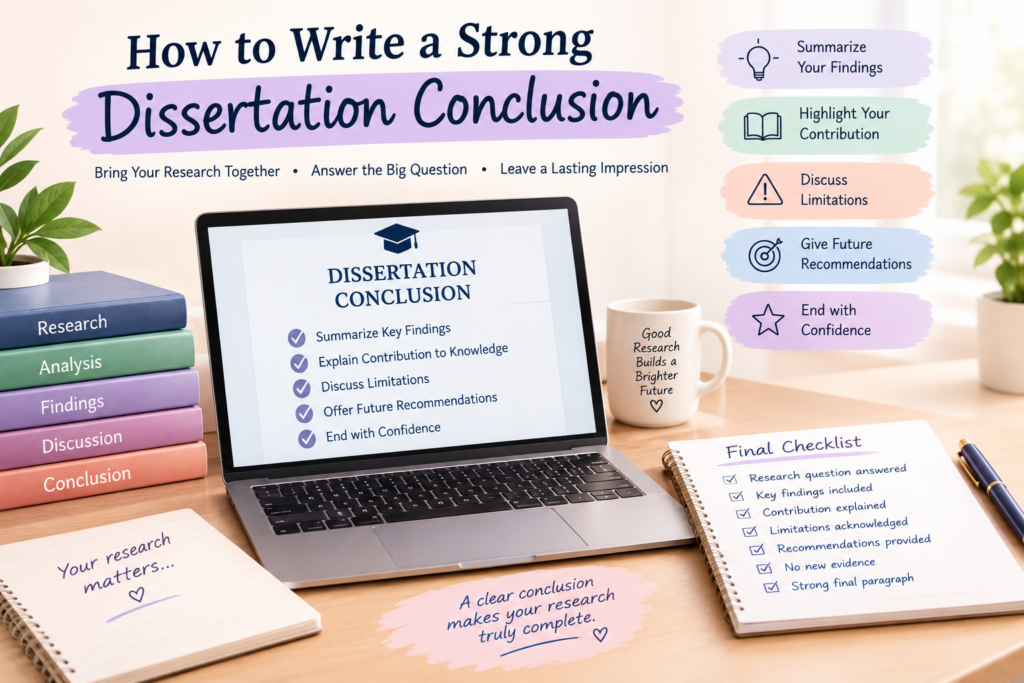
Introduction
After months of research, data collection, analysis, and writing, reaching the conclusion chapter can feel surprisingly difficult. You have completed the hardest parts of your dissertation, yet one important question remains: How do you bring everything together without simply repeating the discussion chapter?
This is where many students struggle. They either summarize their findings word for word, introduce new arguments at the last minute, or write a conclusion that feels rushed and disconnected.
Learning how to write a dissertation conclusion chapter becomes much easier once you understand its real purpose. Your conclusion is not just the final section of your dissertation. It is your opportunity to demonstrate exactly what your research discovered, answer your research question with confidence, explain why the findings matter, and leave your examiner with a clear understanding of your contribution.
A well-written conclusion should feel like the natural finishing point of your research journey. It should be concise, meaningful, confident, and directly connected to the aims you established at the beginning.
What Is a Dissertation Conclusion Chapter?
The dissertation conclusion is where you bring the entire research project together. Instead of examining individual findings in detail, you step back and show the bigger picture.
Think of it as answering one central question:
“After everything I have researched and analyzed, what does my study ultimately tell us?”
A strong conclusion should:
- Answer the main research question
- Summarize the most important findings
- Connect the findings to the research objectives
- Explain the contribution of the study
- Acknowledge important limitations
- Provide realistic recommendations for future research
- End with a strong sense of completion
The examiner should finish reading your conclusion knowing what your research discovered and why those discoveries matter.
What the Conclusion Is Not
One of the biggest mistakes students make is treating the conclusion as another discussion chapter.
Your conclusion should not:
- Copy large sections from the discussion
- Introduce completely new evidence
- Present new theories or arguments
- Add research that was never discussed earlier
- Repeat every finding individually
- Turn into a detailed literature review
The discussion explains and interprets your findings. The conclusion brings those interpretations together and shows the overall meaning of your research.
Discussion vs. Conclusion: Understanding the Difference
The discussion and conclusion chapters work together, but they serve different purposes.
The discussion explores your findings in detail. It compares your results with previous research, explains unexpected outcomes, considers theoretical implications, and examines what your results might mean.
The conclusion takes a step back.
For example, imagine your research examined how social media engagement affects customer loyalty.
The discussion might analyze different forms of engagement, compare your findings with previous studies, and explore why personalized communication appears to influence loyalty.
The conclusion should then bring these findings together and provide a clear overall answer, such as:
The findings indicate that meaningful social media engagement can contribute to stronger customer loyalty, particularly when businesses combine consistent interaction with personalized communication.
That is synthesis rather than repetition.
Students who are uncertain about academic structure often consult resources such as dissertation help USA to understand how different dissertation chapters work together. The goal should always be to use such resources as guidance while developing your own original academic argument.
Dissertation Conclusion Structure: What Should You Include?
Having a clear dissertation conclusion structure makes the writing process much easier. Instead of staring at a blank page, you can work through a logical framework.
1. Provide a Clear Findings Summary
Begin by reminding the reader of the central research problem and summarizing what your research ultimately discovered.
Do not list every result from your dissertation. Focus on the two to four findings that are most important for answering your research question.
A useful approach is to return to your original research question before writing.
Ask yourself:
“If my examiner asked me what I discovered in one minute, what would I say?”
Your answer can become the foundation of your findings summary.
The key is synthesis. Rather than explaining each result separately, demonstrate how the major findings work together to answer the overall research question.
2. Explain Your Contribution to Knowledge
Your dissertation does not need to completely transform your academic field to make a contribution.
Your research may:
- Support existing findings
- Challenge previous assumptions
- Provide evidence in a new context
- Apply an established theory to a different population
- Identify a previously overlooked issue
- Offer practical recommendations
- Highlight an area that requires additional investigation
The important thing is to explain what your research adds.
Avoid exaggerated statements. If your study provides evidence about one specific population or setting, do not claim that it solves an issue for the entire discipline.
A precise and realistic contribution is much more convincing than an unsupported claim.
How to Discuss Limitations Without Weakening Your Dissertation
Many students worry that discussing limitations will make their research appear weak. In reality, acknowledging appropriate limitations can demonstrate maturity, honesty, and critical thinking.
Every research project has limitations.
Perhaps your sample size was limited. Maybe your research focused on one geographical area, relied on self-reported information, or used a particular methodological approach that restricted the scope of your findings.
The important thing is to explain these limitations objectively.
Focus on Methodology
Avoid turning the limitations section into a list of personal difficulties.
For example, saying:
“I did not have enough time to conduct more interviews.”
is less useful academically than explaining how the limited sample may affect the generalizability of your findings.
The examiner wants to see that you understand how methodological decisions influence your results.
Students working on specialized subjects can also review resources such as nursing dissertation help to understand how limitations are presented in different academic disciplines. Use examples for structure and learning, but ensure your own dissertation remains original.
How to Write Useful Recommendations for Future Research
A strong dissertation does not simply identify limitations. It uses them to suggest meaningful directions for future research.
Avoid vague statements such as:
“Future researchers should investigate this topic further.”
Instead, explain:
- What should be investigated?
- Why does it deserve further research?
- What limitation does the proposed research address?
- What different population, method, or setting could be explored?
- How might future findings expand current knowledge?
For example, if your study focused on university students from one institution, future research could examine whether the findings apply to students from different institutions or age groups.
Your recommendations should grow naturally from your findings and limitations rather than appearing as unrelated ideas added at the end.
Students writing law, business, or management dissertations may also look at law dissertation help and business dissertation help resources for examples of how recommendations can be connected to research outcomes.
How to End Your Dissertation With Confidence
The final paragraph matters because it is the last impression your dissertation leaves on the examiner.
A weak ending might simply announce that the dissertation is finished.
A stronger ending reminds the reader why the research matters.
For example:
Weak:
“This dissertation has successfully achieved its objectives and has now come to an end.”
Stronger:
“The findings provide a clearer understanding of the research issue and establish a foundation for further investigation, contributing to the continuing academic discussion in this area.”
The second example sounds purposeful because it emphasizes the value of the research rather than simply announcing its completion.
Your final paragraph should ideally:
- Reinforce the significance of the research
- Connect back to the research question
- Highlight the contribution
- Avoid introducing new evidence
- Leave the reader with a clear sense of completion
Do not try to make your research sound more important than it is. Confidence comes from clarity and evidence, not exaggerated claims.
Common Dissertation Conclusion Mistakes
Even strong research can lose marks when the conclusion is poorly written. Fortunately, most common problems are easy to identify and correct.
Repeating the Discussion
Copying paragraphs from the discussion is one of the most common mistakes.
Instead, identify the central message emerging from your findings and communicate that message concisely.
Focus on synthesis, not repetition.
Introducing New Information
Your conclusion is not the place for a new study, theory, statistic, or major argument.
If something is essential to your conclusion, it should already have been developed earlier in the dissertation.
Overemphasizing Limitations
Limitations should demonstrate critical thinking, not destroy confidence in your research.
Discuss the most significant methodological limitations and explain how future research could address them.
Making Unsupported Claims
Avoid saying that your research “proves” something when your methodology only provides evidence or suggests an association.
Academic writing becomes more persuasive when claims are appropriately measured.
Dissertation Conclusion Length: How Long Should It Be?
A common guideline is that the conclusion should represent around 5–7% of the total dissertation word count, although requirements vary between universities, departments, and degree levels.
For example, a 15,000-word dissertation might have a conclusion of approximately 750–1,050 words.
The exact requirement should always come from your university’s dissertation guidelines.
Remember that longer does not automatically mean better.
If your conclusion is extremely short, it may fail to demonstrate how your research fits together. If it becomes excessively long, it may simply repeat the discussion.
During editing, examine every sentence and ask:
“Does this sentence add meaning, or am I simply repeating something I have already explained?”
Delete unnecessary repetition and strengthen sentences that connect your findings to the bigger picture.
Preparing for Professional and Academic Exams While Writing Your Dissertation
Students balancing dissertation deadlines with professional or admissions exams can face additional pressure. Exams such as the ATI examination require focused preparation, making time management especially important when you are already handling a major research project.
If you are preparing for TEAS exam registration or TEAS test registration, create a realistic study schedule that separates dissertation work from exam preparation. Trying to complete both tasks at the same time without a plan can quickly become overwhelming.
Some students searching online may encounter phrases such as take my TEAS exam for me, take my TEAS exam, or pay someone to take my TEAS exam when looking for shortcuts because of exam anxiety or limited preparation time. However, having another person complete an exam for you is not a legitimate academic strategy and can violate testing and admissions policies.
Instead, use legitimate alternatives such as:
- TEAS practice tests
- Subject-specific study guides
- Qualified tutoring
- Practice questions
- Timed mock examinations
- Official exam preparation resources
- A structured revision timetable
The same principle applies to dissertation writing: getting guidance on structure and improving your academic skills is valuable, but the final work should reflect your own research, analysis, and understanding.
A Simple Checklist for Your Dissertation Conclusion
Before submitting your dissertation, review your conclusion and ask:
Research Question
Have I clearly answered the main research question?
Findings
Have I highlighted the most important findings without repeating the discussion?
Contribution
Have I explained what my research adds to existing knowledge?
Limitations
Have I acknowledged important methodological limitations fairly?
Recommendations
Are my recommendations specific and connected to my findings?
New Information
Have I avoided introducing completely new evidence or arguments?
Structure
Does the chapter move logically from findings to contribution, limitations, recommendations, and final significance?
Final Paragraph
Does the dissertation end with clarity and confidence?
If you can answer “yes” to these questions, your conclusion is likely doing its job.
Final Thoughts: Make Your Dissertation Ending Count
Your conclusion is more than the final chapter. It is your final opportunity to show your examiner that your research has a clear purpose, a meaningful answer, and a valuable contribution.
A persuasive dissertation conclusion does not need complicated language or unnecessary length. It needs direction.
Bring your major findings together. Answer the research question directly. Explain your contribution honestly. Acknowledge limitations without undermining your work. Offer practical recommendations and finish by showing where your research fits within the wider academic conversation.
Most importantly, do not treat the conclusion as something you simply write when everything else is finished. Start thinking about its purpose while developing your dissertation. When you understand the message your research is building toward, writing the final chapter becomes considerably easier.
A strong dissertation deserves a strong ending. With a clear dissertation conclusion structure, careful synthesis, and purposeful writing, you can finish your research with the clarity and confidence it deserves.